Bidvertiser ads

Friday, September 20, 2013

RUROUNI KENSHIN: Movie Review

RUROUNI KENSHIN: Movie Review

By Mark Julian - 1/13/2013

 
Rurouni Kenshin review
When it comes to anime/manga adaptation, the U.S. has a less-than-stellar track record with films like Dragonball: Evolution and Street Fighter: The Legend of Chun-Li. Many fans insist that Hollywood should just leave anime adaptations to their Far East counterparts. While I've generally found myself on the opposite side of that sentiment, Rurouni Kenshin goes a long way towards supporting the other side of the argument. Possessing a strong following in Japan and a devoted fanbase in America thanks to its Toonami run, Rurouni Kenshin should please both hardcore fans and first-time viewers alike. Watching the film, it was as if Takeru Sato (Kenshin), Munetaka Aoki (Sanosuke), Emi Takei (Kaoru) and Yû Aoi(Megumi) stepped out of the anime, each of the main actors channeled the core elements of their respective character admirably. However, in a crowd of strong performances, it's Teryuki Kagawa's turn as the villainous Kanryuu Takeda that steals the show. Kagawa plays Takeda with equal amounts of malice and quirkiness which keeps him from being a one-dimensional antagonist.

While the acting performances are great, if you're watching a film adaptation of Rurouni Kenshin then you're watching for the action. The film does not disappoint. If you're a connoisseur of martial arts films then sword-fights take on a repetitive feel after a while. However, this film features swordplay that's fresh and fluid, making for some of the best sword-fights I've ever seen in a film. And make no mistake, the film puts swordplay front and center and lets everything else fall where it may.

Rurouni Kenshin reviewRurouni Kenshin is one of the more complete films to be released in 2012. Yes, there are certain elements better than others but there are no glaring weaknesses. Everything from the editing and cinematography to the costumes and sets are cleverly executed. When the credits roll and the end song plays, you'll definitely be thinking about where the film can go in sequel. Hopefully, the next entry will have a larger theatrical run in the U.S.

Toriko x One Piece x DBZ Colaboration

Toriko x One Piece x DBZ

oriko x One Piece x Dragon Ball Z Super Collaboration Special
Toriko x OP x DBZ
OVA 3
Information
Kanjiドリーム9 トリコ&ワンピース&ドラゴンボールZ
 超コラボスペシャル!!
RomajiDorīmu 9 toriko& wanpīsu& doragonbōru Z Chō korabo supesharu!!
Duration1 Hour
Release DateApril 7, 2013
Date{{{Date}}}
Opening


Part 1
Summary

ZoroVegetaZebra2(D9)
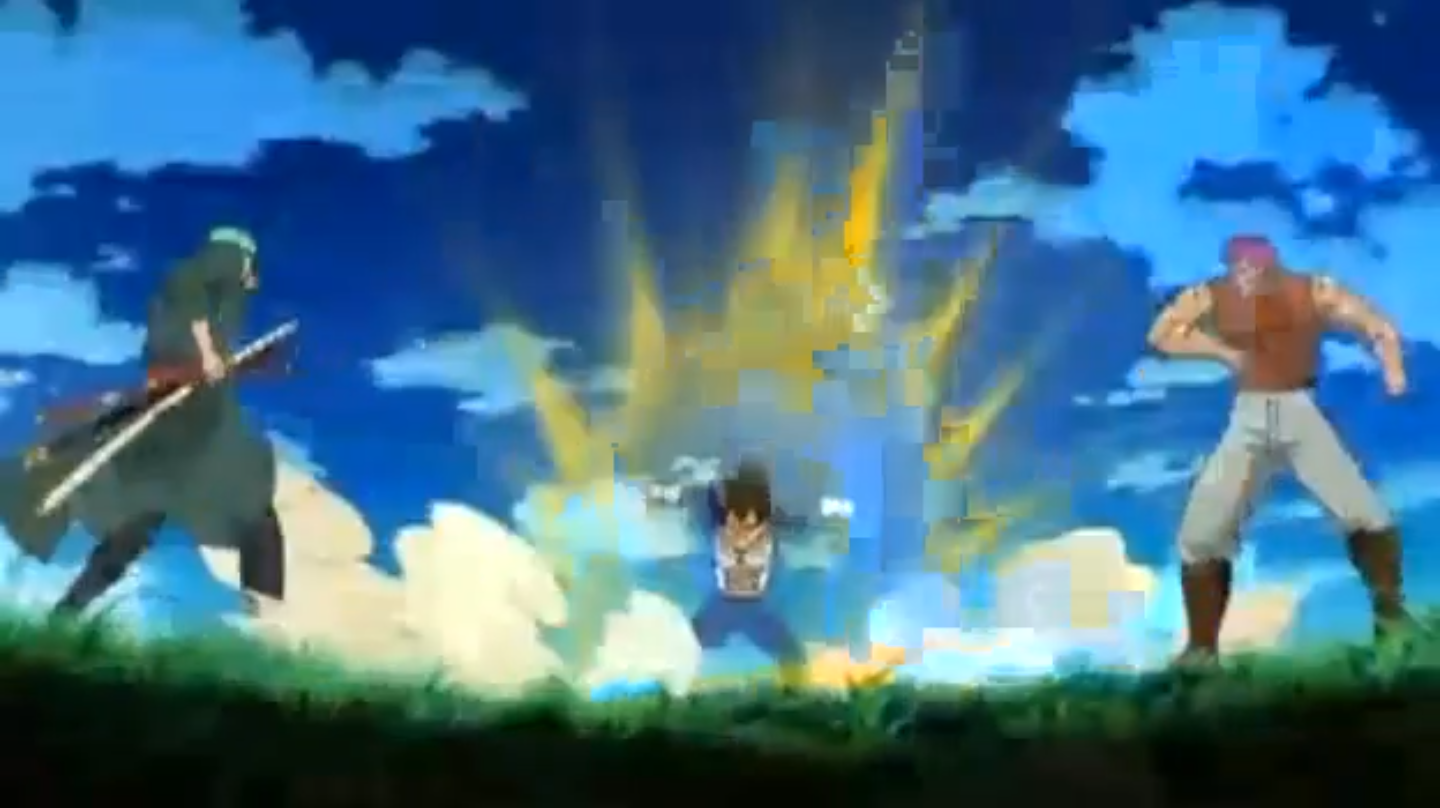
Zoro, Vegeta, and Zebra
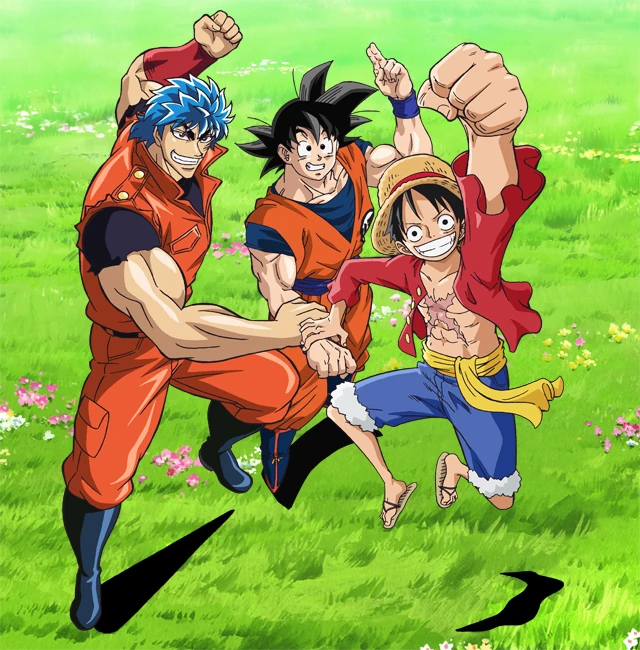
"Run, Strongest Team! Toriko, Luffy, and Goku!" (走れ最強軍団!トリコとルフィと悟空!): TheInternational Gourmet Organization (IGO) is hosting a World's Best Eating Tournament (Tenkaichi Kuōkai), a merciless race with no rules, on a certain island. The tournament's championship prize is the luxuriously rare Carat Sizzled Cattle. Toriko and his friends are aiming for the championship, Luffy and his Straw Hat Crew is set to participate in the event as well, andGoku and his friends are also contestants. The showdown may determine the strongest of the three franchises' leads.
The special also features the following cast of characters:SunnyZebraCoco (the "Four Heavenly King" Gourmet Hunters), KomatsuRinSetsunoTina from TorikoNami,ChopperSanjiZoroFrankyBrookRobinUsopp,Pandaman from One Piece, and GohanGotenTrunks,Master RoshiAndroid 18VegetaPiccoloKrillinTien ShinhanYamchaChiaotzuPuarOx-KingYajirobeKorin, the World Tournament AnnouncerMr. SatanVidel fromDragon Ball Z.
Mr. Satan is the color commentator for the race. He ends up falling into the battlefield, and is the the "official" winner when Goku, Toriko, and Luffy destroy the arena accidentally.
Part 2
Akami4(D9)
Akami attacks the heroes
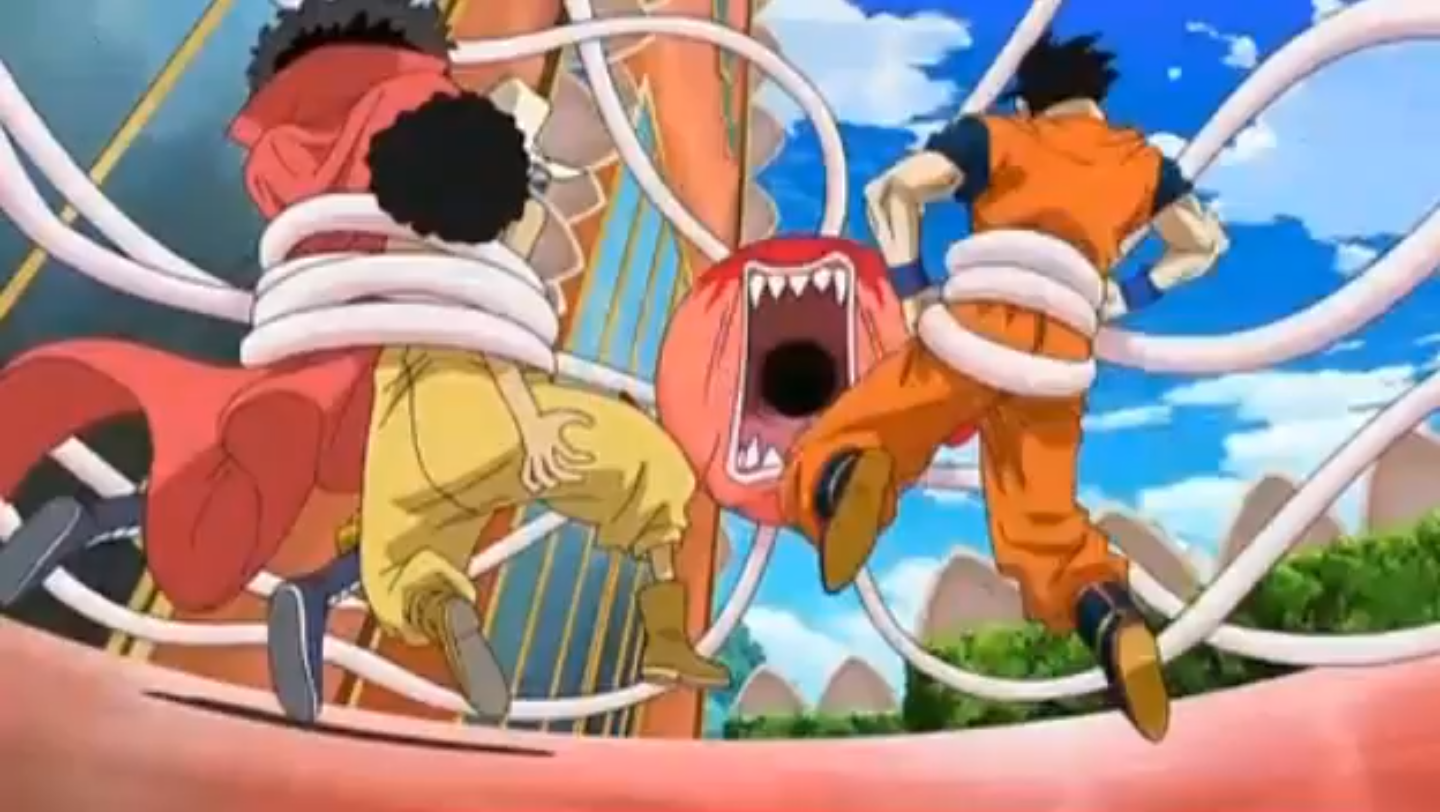
"The Mightiest Collaboration in History vs. the Gluttonous of the Sea" (史上最強コラボVS海の大食漢): After Mr. Satan won the competition, the champion serves up the championship prize, Carat Sizzled Cattle, to Luffy, Toriko, Goku, and their friends. During the meal, the IGO Director Mansam reveals the shocking truth: the tournament was held in order to lure out a Deep Sea Glutton creature,Akami, said to suck out the energy of living things. Soon, sensing Luffy and the other's power, Akami appears from out of the depths of the sea. Goku, Luffy, Toriko may have to combine their powers in order to defeat this deadly monster.

Hajime no Ippo Review

Hajime no Ippo Review

December 28, 2009

story9/10

Hajime no Ippo screenshot
I'm lucky to be female because Hajime no Ippo exists to thrill a viewer's nuts off. Bringing blow after blow of jaw-dropping twists in a narrative that feels as furious as a dog fight, it is the sports anime that challenges all others of its kind to do better.
Essentially the coming-of-age tale of a weakling maturing into the strongest rookie boxer in Japan, Hajime no Ippo doesn't deviate from the sports anime formula in any notable manner. Ippo discovers boxing on a school day like any other then spends numerous staged fights and training montages thereafter rising through the ranks. However, the show outshines all lesser versions thanks to its exceptional script. Simply put, it boasts a bottomless supply of twists to make every fight feel as though it were the first. That Ippo has to win his battles despite his great weaknesses is no spoiler; nonetheless the developments during the fights - their sheer visceral power - obliterate all expectations. Whenever I thought the show had exhausted its store of excitement in one episode, it delivered new unscaled heights of the stuff in the next.
Aside from that, Hajime no Ippo shows that even neanderthals know how to laugh and cry through healthy doses of comedy and character development. Between the hilariously inane penis jokes and the heart-rending personal struggles, the show brings an endearing warmth to what is usually seen as the sport of humourless brutes.
Few anime could rival this series in the shounen ring - the Kyoto arc of Rurouni Kenshin, probably; the first half ofTengen Toppa Gurren-Lagann, maybe; but certainly none of the other sports anime on the market to date. By the end, food and sleep had become peripheral concerns - to sustain myself all I needed was to tap into the show's incredible energy.

animation7.5/10

Anyone visiting a boxing gym in the hopes of meeting attractive, charming young gentlemen is laughably deluded. In the same way, those hoping to find svelte character designs in Hajime no Ippo should book an eye test as soon as possible - the bishounen checked out long ago. In fact,  with a pug-nosed, grotesquely muscular protagonist who looks like a bulldog at best, anyone can be forgiven for thinking the show is a lost cause in the style department.
Luckily, the boxing subject matter means what counts are not the looks, but the moves. And on that front Hajime no Ippodelivers! All fights come complete with spectacular effects - rings of smoke, torrents of wind, claustrophobic closeups - to grab the senses by the scruff and haul them through a powerfully kinetic experience. The action is so absorbing that when a rib cracks, viewers are likely to feel it.

sound8/10

An instant way to deflate the tension during a fight or cheapen the character developments is to watch the American dub. Stick to the Japanese dub, however, and the rewards are plenty.
Aside from the decent original voice acting, the show delivers blood-pumping electro beats, cool rock riffs, and a ditty that's a cheeky herald to the Rocky theme (it had to be done!). At its best, the soundtrack offers excellent opening themes, in particular the outstanding third instrumental theme 'Tumbling Dice'.

characters8.5/10

With seventy-five episodes to fill, Hajime no Ippo comfortably handles a large cast of macho men. (What about the women, you say? You mean those ugly things they occasionally bring out to cook and clean and generate fanservice? Yes, there are some.) At the forefront, Ippo's personality from meek door mat to sporting icon develops in a compelling, accumulative manner - once at the end, his beginnings as the worm his bullies once called him are difficult to believe but easy to retrace. Then, at a count, there are half a dozen memorable fighters apart from Ippo who deliver such outstanding performances that they sometimes outshine the titular hero. Whilst their punches hurt, it's their aching backgrounds that inspire tears; moreover, when two of them fight, be prepared not to know who to root for.

overall9/10

"You don't get to see a match of this calibre every day. As a journalist, I wish I could have seen these two fight on a larger stage." - Fuji, on Ippo's final battle
You don't get to see an anime of this calibre every day. As a life-long anime fan, I wish I had watched Hajime no Ippo much sooner. From its butt-ugly head to its brawny toes, the series packs such intensity that my poor monitor emitted not sparks but vapours of sweat. It is the kind of rare event that inspires anyone to power through two-hundred squats and step out into the street asking random strangers to punch them in the stomach... or was that just me?! In any case, watch with a heart bypass surgeon at the ready because this show promises the full workout from your seat!

Samurai X: Reflection

Rurouni Kenshin: Seisouhen Review

by: vivafruit
July 6, 2007

story6/10

Rurouni Kenshin: Seisouhen screenshot
Note: I hadn’t read a single page out of the original Kenshin manga when I wrote this review. This is probably an important factor to me enjoying the show. Also, this review contains minor spoilers for Rurouni Kenshin: Tsuiokuhen and the Rurouni Kenshintelevision series.
There has been a lot of talk over whether this anime is “faithful” to the spirit of Kenshin. Admittedly, this show is a very strong departure from the TV series or even Reminiscence. While in the anime’s predecessors Kenshin is generally shown as a man of strong spirit, mind, and body, in Rurouni Kenshin: Seisouhen he is shown as something entirely different – a feeble, listless individual filled with doubt and regret. Even his character design is significantly changed – the new one feels not only older, but also immensely weathered from the previous trials of his life. The abrupt change is somewhat startling, and is probably a very large reason as to why many people dislike Seisouhen.
However, to me, this transformation seems almost inevitable. As the first episode of the OVA makes clear, Kenshin can never truly be rid of his past sins. The immense guilt he feels for those he has slaughtered can never be washed away, no matter how many good deeds he does to assuage his inner suffering. Seisouhen’s portrayal of Kenshin as a character feels like the logical conclusion to what is shown in Reminiscence and the TV series – as time goes on, Kenshin must realize that he can never escape his bloody origin, the legacy left by his former wife, or the ruthless killer that he once was. In a way, Kenshin has been dead far before the TV series even started; by taking up the sword to kill, he has long since traded away an important part of his humanity. Everything since then has merely been a futile try at redemption, an attempt to regain what he has long since lost. As Kenshin gets older and weaker, he can no longer distract himself; he instead must finally confront what he has done.
In the absolutely excellent Tsuiokuhen OVA, Kenshin realized that his philosophy of killing people to save people was wrong. As a result, he chose to never take another human life, and to atone for his sins through saving the lives of countless individuals. Here in Seisouhen, Kenshin realizes that his new world outlook is also unrealistic – no matter how many individuals he saves, he can never bring back the ones he has killed.
The way that Kaoru fits into this is that, well, she doesn’t seem to fit in. Kenshin has already lost so much that whether there is any more room in his heart for Kaoru seems dubious. Amazingly, in Seisouhen, Kaoru seems just as tortured as Kenshin’s first wife, Tomoe. While Tomoe was torn between her simultaneous hatred and love of the man, Kaoru doesn’t even know if Kenshin cares for her. Did he marry her out of his seemingly infinite kindness, or does he actually need her as a companion?
The entire first episode of Seisouhen is devoted solely to this single burning question. As Kaoru looks back on her life, she almost frantically searches for signs that prove Kenshin’s true love. Some may call these flashbacks a rehash, but I strongly disagree. Though Kaoru is remembering events that transpired in the TV series, here in this OVA they are given an entirely new context and meaning. Gone is the cheerful, optimistic air that permeated the series; instead, the events are retold through the eyes of a desperate woman wondering if she has wasted her life loving someone who is incapable of loving her back.
The second episode… well, I won’t go into specifics. However, allow me to say that both Kenshin’s seemingly undying guilt and Kaoru’s possibly futile love are resolved amazingly well. Will Kaoru finally know that she is a part of Kenshin? Will Kenshin ever be able to find true, untainted peace? Seisouhen refuses to take the easy answers.
Finally and most importantly, does this anime go against the “spirit” of Kenshin? Yes and no. While this OVA definitely diverges from what I remember the TV series for, it provides something that is just as good. Seisouhen can be viewed as an alternate interpretation of the characters of Kenshin and Kaoru; a darker approach filled with regret and despair. A few people seem to believe that this OVA contradicts the original storyline, but I heavily disagree with that. Both Tsuiokuhen and the Rurouni Kenshin TV series had all of the themes seen here; inSeisouhen, however, they are merely much more emphasized.
Unfortunately, the anime's storyline is remarkably disjointed. Much more time should have been devoted to certain parts of the plot, and the anime’s fragmented, rushed approach to tell the story borders on confusing. Finally, I for one don’t really understand why the creators decided to include the small portion of time devoted to Enishi. Enishi clearly deserves several episodes just for himself, not the 10 minutes given to him in the 2 episode OVA. There wasn’t really a way to do the character justice without spending a lot more time on him, and it probably would have been best if they had not included him at all.
However, the storyline also has moments of incredible power. In particular, I found the ending to be absolutely amazingly carried out, and the flashback scenes were poignant and served to cast the old scenes in an entirely new light.

animation7.5/10

Seisouhen’s is definitely below the incredible animation seen inTsuiokuhen, but I was nonetheless still very impressed. While not quite as fluid as its predecessor,Seisouhen sports absolutely excellent character designs as well as beautiful background scenery. The various swordfights are competently executed (although not outstanding), and the facial expressions are very nicely handled.

sound9.5/10

Seisouhen’s soundtrack is every bit as excellent as the first OVA’s, and voice acting is just as good, if not better. Theres a pretty wide range of emotion covered in the story, and the seiyuu do a fantastic job in every case.

characters9/10

The fantastic characters of the original Rurouni Kenshin are drastically reinvisioned in Seisouhen. Some might be at odds with the changes, but I thought they added further depth and insight into some already fantastic characters.

overall8/10

I’ve been delaying watching this OVA for a long, long time. When the anime was first released, the negative hype was astounding; talk of defiling “the spirit” of Kenshin was rather common, with the ending in particular being complained about. I soon became convinced that the work was a clumsy, incompetent work that simultaneously confused those who had not read the manga and outraged those who had. Seisouhen was vilified so much, in fact, that I avoided it for several years before a series of outstanding AMVs piqued my curiosity enough to watch the show. However, what I experienced is not the "disgraceful" anime that I was expecting; on the contrary, Seisouhen is a remarkably powerful work.
Whether or not this is something worth seeing seems to depend largely on the individual; some like Seisouhen, and others hate it. However, I for one was captivated by the incredible depth added to Kenshin and Kaoru, as well as the very nice animation and the excellent soundtrack. Although the storyline is definitely lacking, the other elements of the anime more than make up for its shortcomings, and in the end I was thoroughly impressed. Granted, the anime doesn’t come close to matching the excellence in Tsuiokuhen, but few animes do.

Samurai X: Trust and Betrayal

Rurouni Kenshin: Tsuiokuhen Review

by: kamenoko
August 11, 2006

story10/10

Rurouni Kenshin: Tsuiokuhen screenshotIt is difficult to explain why Rurouni Kenshin - Reminiscence is the best piece of animation, ever. The best I can come up with is that it distilled the television series down to its best components: A Samurai epic, and a love story. But this isn’t true, what makes Reminiscence the best animation ever is what was left out: cute secondary characters, announcing your attack before actually doing it, long drawn-out explanations of how said announced attack worked, plus leaving out a European Knights arc, and a feng shui arc. I shall get into more detail presently.

From the outset of the Kenshin OVA we know two things: these are violent times, and we shall see a lot of violence. But this isn’t Ninja Scroll II, and balancing out the spraying blood is a love story that isn’t merely tacked on, but weaves in and out of the swordplay like a comforting spirit. The love story brings about the cathartic release that all great tragedies have, it is also the source of the tragedy in this OVA in the first place. I hope I’m not giving too much away, but anyone who has seen the series beforehand knows that this is at least hinted at many times. The story for the Kenshin OVA provides the foundation on which two great pillars arise, the animation, and the characters; I shall begin with the animation.

animation9/10

Beautiful is how I must start, for it describes the animation perfectly. Realistic is how I must continue because there is no mouth stretching, chibi-fying, or any of that stuff. Poetic is how I must end this particular style, for the animation is so smooth it reads like the most exquisite poetry, and I cannot keep up this style much longer.

There is only one flaw I can find in the animation of the Kenshin OVA, and that is the inclusion of several live action shots: one depicting trees, and one depicting water. I felt this took me out of the experience of the animation itself, but it is quite a small nit to pick for neither of these sequences last more than five seconds.

Like I’ve already outlined, the animation is beautiful, and while it’s still easily identifiable as Japanese animation, the Kenshin OVA is the most realistically animated pieces I’ve seen. The sword fights are what they should be; short and violent. Nowhere to be seen is the long, drawn out fight sequences which I felt marred the original Kenshin TV animation. Himura Kenshin superiority is readily apparent, no one save for three* individuals stand against his sword very long. I also must mention the meticulous nature of the animation, the design of everything from rice bowls to umbrellas is quite spectacular. It’s these little touches that immerse you into the OVA.

sound10/10

I have already covered most of the Voice Acting aspect of the Kenshin OVA, save for that the rest of the cast live up to the incredibly high expectations we have for Japanese seiyus.

I know I’m beating you folks over the head with all this attention to detail nonsense, but I must do it once more. The craft that went into creating the sound effects for the Kenshin OVA is incredible. Everything sounds as it should be. The sounds of swords striking, the sound of wood being chopped, everything is exceptional, and the sentiment only grows with repeated viewing.

The music for the OVA is like the rest of anime: at most times understated, but vibrant and powerful when the time comes. The OST is well worth a listen, for the dramatic and battle themes alone, but there are more gems in there that warrant repeated listens.

characters10/10

Due to the length of the Kenshin OVA (around one hundred and twenty minutes) there are only really two characters of note: Kenshin and Tomoe. Both these characters have divided hearts: Kenshin does not wish to kill, but feels he needs to so that a new world can be created where all Japanese are equal. Tomoe must balance her desire for revenge with a burgeoning love. But like with the animation it’s the small details make the characters so immersive. The way that Kenshins spinning top is his last link with a lost childhood, and the knife is Tomoes last link with a lost love. The parallels are incredible. The differences between character even more so: Kenshin kills and Tomoe tries to sheath his violence. I can’t find the words to describe how well the director presents these characters.

The voice acting is superb as well, and while I’ve heard complaints about Kenshins seiyu being female, I find it unfounded. I cannot imagine Kenshin’s voice as being anything other than it is. Mayo Suzukaze has a subtlety to her voice that gives the teeth of Kenshin’s character. A lesser talent would have made him sound like Clint Eastwood in his Man With No Name days, gruff, bleak, and already weary with the world. By making Kenshin’s voice softer the juxtaposition with his violent nature is made all the clearer, and the impact all the greater.

Tomoe’s Seiyu, Junko Iwao, gives us an understated performance. Tomoe does not raise her voice, even at its most emotional, it is still quite reserved. Its subtlety is a perfect match for Kenshin’s, and it forces us to divine states of mind, instead of having it explained to us in some great exposition.

overall10/10

The Kenshin OVA is an aural and auditory treat, as well as a pleasant mental exercise. This is the anime you should watch, period. If you haven’t watched this anime yet, then watch it now, it really doesn’t matter if you’ve the original TV animation, though it helps define the dichotomy in Kenshin’s character. If you have watched it, watch it again, you’ll discover something else to love about this animation after every viewing. This anime is worth every penny it costs, and then some; for it will provide you with potentially hundreds of hours of good watching.

* Two of three I can mention Seijuro, Kenshin’s teacher, and Saito, one of Kenshin’s foils from the TV series, though this is the Saito from his Shinsen Gumi days. The third I can’t mention, and the bastard cheats!

Thursday, September 19, 2013

Iron Man: Rise of Technovore Review

May 2, 2013 by 

I wanted to like this film.  Hell, I even wanted to love this film!  But that was not meant to be.  Iron Man: Rise of Technovore is an anime film produced by Madhouse and Marvel, the same duo that brought us Marvel Anime (Iron Man, X-men, Wolverine, and Blade).
There are quite a few problems with the presentation of the film.  The biggest problem that I had with it is the inconsistent tone.  I'm not talking about in writing (i'll get to that), I am talking about just in the visuals.  For example, during one fight scene that takes place outside in the air the scene switches to a stylistic "angry" iron man only to instantly switch back to the fight.  I know it was meant to look cool, but it just breaks the flow and seems very out of place.  This happens several times throughout the film.
The writing in the film isn't terrible but their certainly were some moments where I thought "Well that is a lame line".  Example (as can be seen in the trailer below) when Pepper Potts replies "Says the billionaire playboy who makes things go boom".  Who makes things go boom.....really?  That seems like it was written to appeal to 7 year olds.  Maybe this movies target audience is 7 year olds and I'm the wrong demographic for it but little lines like that really ripped me out of the experience.  Having said that, the film does utilize its anime style quite well on occasion with some really fascinating shots like Tony putting on the Iron Man armor mid-battle while running.
Then comes the story.  I have a theory about this film in that it was actually supposed to be season 2 of the Iron Man Anime, but instead of offering 12 twenty-five minute episodes we got one 80 minute film.  As such,  all of the plot threads (of which there are many) feel really rushed and some don't even have proper closure.  For example,  The Punisher is in the film for maybe 7 minutes.  That is just a glorified cameo, yet they tried to convey a whole story about him and his relationship with Shield and Tony Stark in that time as well as progress the plot for Iron Man seeking out his mysterious new adversary.  Then there is this entire other subplot about Shield hunting down Tony Stark so they send Black Widow and Hawkeye after him but with how much development it is given it only serves again as glorified cameos and an excuse for some action.  With proper development, these plots could have really been impressive which is why I think it was Iron Man Anime season 2 that had to cut most of its content leaving only a shell of what it could have been.
I alluded to it earlier, but I'm not really sure who this film is for.  Is it for Anime fans?  Marvel comic fans?  Fans of the Marvel feature films?  Older audiences?  Younger audiences?  For example, the dialogue can sway towards childish, yet the art is hypersexualized anime with rippling muscles and womens bosoms trying to escape there clothing.  Yet the story is so convoluted and rushed that fans of the comics are likely to be put off by the weak portrayal.  I have no idea who the target audience is but I can't help but feel they missed the target.  Its not strictly a terrible film, its just not a good one.  Actually, this might be the worst Marvel Animation film yet (Iron Man and Hulk: Heroes Untied looks like it will be taking that crown shortly though.........) though it wasn't so bad that I wanted my time back after watching it.  Its just not worth paying much for.  I rate this film:

Hunter × Hunter -The Last Mission- Film's 1st Trailer Unveiled

Hunter × Hunter -The Last Mission- Film's 1st Trailer Unveiled

New film revolving around the dark side of the Hunter Association to premiere on December 27
The first trailer for the Hunter × Hunter -The Last Mission- film began streaming on Monday. The trailer asks viewers if they are prepared to know the history of the Hunter Association that was engraved in flames, and demands that those who have committed sins to pay for them with their lives.
The official website for the Hunter X Hunter film also updated to show the new film's key visual.
The story of the second film adaptation of Yoshiro Togashi's Hunter X Hunter manga revolves around the dark history of the strongest Hunters that once existed in the Hunters Association that were split into “light” and “dark”, with each walking down their respective paths. The “dark” side begins moving in order to massacre all Hunters, and both Killua and Kurapika are caught up in the violence and are injured. What is the dark secret behind Netero, the strongest Nen-user and the chairman of the Hunter Association?
The production of the second movie was announced at the end of the Hunter × Hunter: Phantom Rouge film when it premiered in January. The movie took the #1 spot at the box office when it opened.
The movie will premiere in Japanese theaters on December 27.

Berserk Review

Berserk Review

May 23, 2008

story8.5/10

Berserk screenshot
While I would have liked to begin with a witty, intellectual line about how great Berserk is, I just couldn't find the right words to do it. For some reason, Berserk defies any attempts at clever analysis, meaning that I'm left with no option but to say it how I feel:Berserk is hands down one of the best anime around. It may not turn out to be one of your top favourites; it may put you off with its dated appearance; and heck, its final episode is likely to leave you royally pissed. Regardless, I'll bet you any amount you name that it will still knock your socks off.
As unfair as it seems in hindsight, Berserk's opening scenario of innocent tavern girls getting bullied and monsters terrorising villages reminded me too much of some of the demon hentai I've come across. Needless to say, my expectations of Berserk thereafter hit rock bottom; by the end of the first episode, however, I had changed my mind all over again. What I discovered was that while the setting looked like a shit idea, the character and plot developments were something else altogether. Gatts' encounter with the demon lord in the first episode instantly raises the question of how a man could be so remorseless, and the subsequent flashback begins the epic story that provides the answer.
What is surprising about Berserk's plot is how well its various elements come together: take the story of a man who wants greatness at all cost; add a corresponding tale of a man who thinks of nothing but fighting his next battle; stir vigorously with demons and gore; sprinkle some ingenious military-political manoeuvres on top, and what you get is a potent blend of fantasy action. Moreover, Berserk has a knack for pacing and structure; just when I think the messianic plot themes and cataclysmic battles couldn't be more melodramatic, Berserk presents a touching flashback during which the characters reveal something interesting about their pasts. I'm not usually a fan of flashbacks since they interrupt the flow of a story, but in Berserk's case, they feel more like a vital part of the experience than a convenient plot device. For example, the story of Caska's first encounter with Griffith had me glued to the screen as intently as any of the scenes of clashing armies and monster fights. In fact, Berserk had me so engrossed that every episode felt like it ended ten minutes too early.
This only leaves one glaring problem, namely the fact that it doesn't end. I can't emphasise this strongly enough, but Berserk comes to the kind of screeching halt that could feed a rant for pages and pages. The anime covers perhaps a quarter of the manga's plot, and to make things worse, it stops halfway through an arc! Even pre-warned I still wasn't prepared for just how abrupt the ending turned out to be. For many, the disappointment will be acute; and for that kind of pain, I can only recommend the manga as a cure, which continues with the same (if not better) level of quality.

animation7/10

Apart from the extravagant monster designs, Berserk's concept looks lifted straight out of some generic high fantasy novel; with knights in full armour, moats and castles, shining fairies, and swords aplenty, there is really nothing too exceptional about Berserk's European universe.
At its worst, Berserk suffers from an impoverished budget, which is evident considering the frequent use of still shots and the low number of frames in some of the action scenes. I have never been particularly bothered by either of these flaws if the story is good enough, and in that regard, Berserk more than compensates.
Problems aside, some of the character concepts are pleasantly surprising; Griffith's icy appearance, Caska's unusually dark skin, and Gatts' rippling build and oversized sword are instantly eye-catching. Also, while the action sequences may not be much more than adequate when compared to more recent anime, I do like their gritty approach to violence.

sound7.5/10

Berserk's soundtrack is not particularly varied; almost all of the intense scenes with a score use only a slight variation of the same theme. However, the little there is makes for a pleasant listening experience and never gets old despite the repetition. Besides, the lack of variety is probably due to the fact that Berserk relies far more on natural background noise to create tension.
Although faced with a script that is occasionally laden with cheese, Berserk's Japanese voice actors still manage to deliver some truly emotional dialogue. For instance, the villains issue macho threats and chuckle with nefarious delight, but the protagonists tend to have serious tones which are full of subtle nuances. Notably, Griffith has a softer voice than I expected, although it fits his cool, intelligent demeanour like a glove and even makes him seem doubly sinister on occasion. Predictably, the American cast are only half as good; I could only stomach a few episodes of their daytime drama acting. If possible, avoid them at all cost.

characters9.5/10

What is impressive about Berserk is that it has no weak cast members to speak of; not one of them falls short of delivering a convincing performance. Granted, the stock characters such as Princess Charlotte remain far less developed than the protagonists, but they still manage to fit the story to a tee. As for the central characters, they are unexpectedly complex and emotionally engaging on every level:
Gatts is a traditional tortured hero type who carries the burdens of a dubious origin and a disturbed past. What makes him a great lead character despite being a stereotype on the surface is that he embodies, in the bluntest way, what makes a person likeable; he has a raw, honest personality which, despite his reticence, still comes across as touchingly vulnerable. Besides, he may not be people-friendly, but he kicks a lot of arse and he saves people, and he does it all with a sword twice his size.
Griffith, as far as the anime is concerned, is probably Berserk's strongest standalone element (in the manga, Gatts is definitely more interesting). He is beautiful like an angel and radiates the kind of charisma that moves armies and topples kingdoms; what's more, he is inhumanly cunning and generally the kind of character you can fall for over and over again. However, the guy is also undeniably fucked up. As Griffith leads the Band of the Hawk to glory and wins hearts as well as minds, there is always an element of doubt concerning his true intentions; of course, this only serves to make him all the more engaging.
As the only female to have a significant role, Caska exceeded my initial expectations; she doesn't have big tits or bare long legs, and she has both common sense and superb fighting skills. Intelligent, a leader within the Hawks, and harbouring an intense loyalty to Griffith, she is a character with a distinct purpose. Caska's only downfall is that, as the series progresses, she gets forced back into a predictably misogynistic role.
With regards to the supporting cast, the members of the Band of the Hawk are easily the most memorable, with Judeau ranking as my favourite; whilst he may be young and have relatively little screen time, his wisdom and perceptiveness when it comes to his comrades is refreshing. Corkus, on the other hand, is another great character whose relentless dislike of Gatts provides for some much-needed comedy; I also like the fact that he adds a more pessimistic nuance to the Band of the Hawk dynamic. All in all, these are the kinds of characters for which I harbour deep nostalgic feelings; their strong personalities and intricate development makes them difficult to forget.

overall8.5/10

The villains can be cheesy; almost every scene involves someone getting gutted or having their limbs chopped off; and the demons tend to eat people just for the heck of it. All of this would usually result in an anime that is mediocre at best and probably doomed to obscurity. However, Berserk's superb character development and uniquely messianic plot makes it not just an accomplished piece of fiction that somehow survives its terrible ending, but an undeniable masterpiece at that.